
For those of you who haven’t read either of my two books, Grace Happens and Reflections of Consciousness, they both feature appendices titled Soul Food and Soul Food Rave Reviews, respectively. The first lists many of my favorite spiritual resources from throughout the course of my sadhana, while the second comprises a sample of my Amazon reviews of books that I’ve read post-Awakening. As these were a hit with many readers, and as I’m constantly running into more exceptional, maya-mashing content, I am keeping the tradition alive by periodically contributing a Soul Food column to Eli’s Insights newsletter. For those who may have missed out on these when they first were published, or for newsletter readers who may want to revisit and/or share them with others, we thought it would be useful to have them all archived here in one blog post, which will be updated when more are published. Just click on the arrow to expand each section, containing one Soul Food article. May something in them assist you on your unique and wondrous journey toward the within!
Love and Light,
Phil
When I penned my July Soul Food article about Dr. Rob Newton’s recently published tome on Sufi mysticism, I mentioned that I was also going to read his new book on Zen, titled The Original Face: Chan Masters in Their Own Words. While I wasn’t as taken with it as I was with his treatise on Sufism, I still found a great deal of wonderful content within it, a beautiful sampling of which I’m sharing with you here.
Unlike my other Soul Food posts, however, instead of providing a collection of short, pithy gems from throughout the book (and there are many of these), I stitched together a few sentences and paragraphs from the chapter titled Huangbo – The Transmission of Mind. Huangbo (Huang Po) is universally acclaimed as one of the most revered Chinese Chan (Zen) teachers in history. He has always been my favorite icon from Zen and he’s one of the four Masters who comprise my “Zen Mount Rushmore,” the other three being the Third Zen Patriarch Seng-ts’an (Sengcan), the Sixth Zen Patriarch Hui-neng, and the towering Japanese Master Dogen (with honorable mentions to Hui Hai and Bankei, both of whom I greatly admire).
I liked this distilled message so much that I read it at the culmination of Eli’s monthly in-person Realization Group meeting in September. While its wisdom is for everyone who resonates with it, I feel it may be particularly helpful to those who are “beginning” their spiritual path. All word emphases are mine.
Love and Light,
Phil
The seeking creates the illusion of separation. What makes this so difficult to see is that we are addicted to becoming. We want stories of transformation, tales of struggle leading to breakthrough, promises that if we just practice hard enough, we will wake up. But Huang Po keeps pulling the rug out from under every story. “Mind is Buddha. No-mind is the Way. Just be ordinary. Don’t seek.” These are not inspiring slogans — they are direct attacks on our fundamental delusion that we are separate from Awakening.
This isn’t saying you shouldn’t practice — it’s saying practice cannot produce what is already the case. The moment you think “I am practicing to become Awakened,” you have created duality where none exists.
But we cling to our methods like drowning people clutching at straws. We want guarantees, timelines, measurable progress. We want to know that if we sit for so many years, attend so many retreats, complete so many prostrations, something will Shift. And something does Shift — but not in the way we think. What Shifts is that we begin to see through our own seeking. We begin to notice that the seeking itself is already it, already the activity of our True Nature expressing itself.
This is why Huang Po’s teaching is so terrifying and so liberating. He offers nothing to hold onto. “Just this mind is Buddha. Outside this mind there is no Buddha, no dharma, no path, no practice, no Realization.” Every method you devise to reach this Truth is already too late — You Are Already It. Every technique you employ to become what you think you should be is already the expression of what you actually are.
The tragedy is that we use methods to avoid the direct encounter with What Is, Here, Now. We fill our lives with spiritual practices the way we fill them with entertainment, work, relationships — anything to avoid the simple fact of This Moment, this breath, this awareness that cannot be grasped or improved upon. We would rather have a complicated path with stages and levels than the devastating simplicity of what Huang Po points to.
But what does this mean for someone who has felt the pull but not yet Seen? It means Recognizing that your very sense of being lost is already the activity of your True Nature. The confusion, the seeking, the frustration with practice, the hope for breakthrough — all of it is already complete Manifestation of the One Mind. You cannot fail at this because there is no one separate to succeed or fail.
This is not permission to abandon practice. It is invitation to see what practice actually is. When you sit, just sit. Not to become Buddha — sitting is already Buddha activity. When you chant, just chant. Not to gain merit — chanting is already the Universe expressing Itself as sound. When you work, just work. Not to build karma — working is already the spontaneous activity of Awakening.
This is why Huang Po keeps saying “Just be ordinary.” Because in ordinariness, there is no gap between What Is and what should be. When you drink tea, just drink tea. When you walk, just walk. When you breathe, just breathe. Not because these activities will lead to Awakening, but because they are already the complete expression of your True Nature.
What does this require? Nothing. And that nothing is the most terrifying requirement of all. Because in that nothing, there is no one to become Enlightened, no path to travel, no method to employ. There is only This — Just This — eternally This.
Readers of my second book, Reflections of Consciousness, will know that two of the teachers and traditions I deeply immersed myself in during the early post-Awakening years were Plotinus (Neoplatonism), and Ibn ‘Arabi (Sufism). I’ve read many books on both, which fall broadly into two categories: scholarly and non-scholarly. For my purposes, all the books I explored had value, but overall I found the former category to be on the dry side, while the latter one sometimes lacked historical/factual precision. Moreover, relatively few books impart the Spirit of the teacher and their teaching, a vital ingredient that I’m always on the lookout for. I don’t read to accumulate knowledge anymore, although a few things do stick around in my aging memory bank somehow. Instead, I read spiritual texts to absorb the essence of their Truth, embedding it into my consciousness so to speak. The better I can do this, the more I’m able to appreciate the beauty of the teaching and consequently, more coherently share it with people like you.
Therefore, when it comes to recommending a book in general, and specifically about the above two teachers and their respective spiritual heritages, I point to the texts that exemplify the often hard to find “sweet spot” between pedagogical rigor and essential flavor. The two books featured in this edition of Soul Food handsomely hold both criteria, hence my endorsing them.
~~~
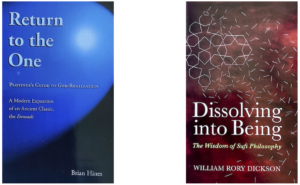
The first is the superb 2004 work, Return to the One: Plotinus’s Guide to God-Realization by Brian Hines, which he describes as “A Modern Exposition of an Ancient Classic, the Enneads.” The following are three brief excerpts that I hope will give you a feel for this study of Plotinus:
Plotinus isn’t telling us anything new, nor is he telling us anything complex. The meaning of life (or, we might say, that which gives life meaning) is to be found as close to home as could possibly be imagined: right within, or more accurately as, the center of one’s consciousness.
WISDOM LIES WITHIN, not without. The only way to know divine truth is to unite one’s consciousness so fully with it as to become it.
For Plotinus, the task of the philosopher will not be to deliver a discursive exposition concerning the principles of reality, but rather to remind the reader to ‘turn the act of awareness inward, and insist that it hold attention there.’ (Enneads Vl.12.15)
~~~
The second is the terrific 2025 book, Dissolving into Being: The Wisdom of Sufi Philosophy by William Rory Dickson. His welcome book provides a contemporary commentary on Ibn ‘Arabi’s preeminent treatise, The Ringstones of Wisdom (Fuṣūṣ al-ḥikam). Below are two soulful morsels for you. The first is about the book and the second is a quotation from Ibn ‘Arabi read by Dickson, both from a September 24, 2025 lecture/conversation published May 20, 2026, on The Institute of Ismaili Studies YouTube channel.
Dickson explains the Sufi philosophical perspective rooted in the Islamic creed – “There is no god but God” – as pointing to the idea that God alone has real being. Appearances in the world are real in that they are encountered and found, but they point to a single underlying Reality (“Being”). God is the only true Real, while creation manifests this Reality in multiplicity.
It is no secret that beliefs are diverse. So whoever restricts the Real to his own belief denies Him in everyone else’s belief, affirming Him only when God discloses Himself in a way that conforms to his own belief. Whoever releases God from restriction, however, does not deny Him, but rather affirms Him in every form that He transforms Himself into and worships all of the forms in which He is manifest infinitely. For the forms of His self-manifestation have no end. ~ Ibn ‘Arabi
~~~
I hope these delightful dishes of Soul Food nourish your spirit as they have mine and assist with the Remembrance of your inherent Unity in and as All Things!
Love and Light,
Phil
Until now, all my Soul Food posts for Eli’s Insights newsletter have featured podcasts and YouTube content. This wasn’t by design, but rather they were what felt intuitively appropriate at the time. Changing directions now, there’s a 2026 book asking me to share it with you. It’s called The Wine of Annihilation: A Complete Journey Through Sufi Mysticism by Rob Newton, M.D. Prior to this being published, I wasn’t aware of the author and hadn’t read any of the others in his six-book The Primordial Light Collection. I do have his The Original Face: Chan Masters in Their Own Words in my reading queue though and am looking forward to perusing it soon.
At nearly 700 pages, The Wine of Annihilation packs a lot of bang for your buck! But don’t let its size dissuade you, as I found it an easy read filled with innumerable (and often succinct) pearls of wisdom that, in the tradition of Lectio Divina, one can effortlessly take in and then put the book down, allowing the pointer to be absorbed into one’s consciousness.
To provide you with a flavor of the book’s wisdom, I am sharing the following 18 beautiful excerpts, two with bracketed info from me for context. As always, I pray this newest Soul Food will assist you with your ever deepening and wondrous Journey Toward the Within!
Love and Light,
Phil
The broken cage does not free the bird, it reveals that the bird was never caged except by its own forgetfulness of wings.
The closer the lover comes to the Beloved, the more he finds himself disappearing.
The return is not to a place but to a recognition. The One was never lost, never separate, never anywhere but here. The exile was real as experience but unreal as fact, the way a dream is real while dreaming but unreal upon waking. These [Sufi] poems don’t describe the journey from here to there but the recognition that here is always already there, that the many was always already the One playing at being many, that the wound of separation was always already the joy of return seen from the inside of the forgetting.
The desert is endless, not because it is vast but because it is the same moment of separation repeated endlessly until the moment of recognition arrives.
Your attempts to “unite with” God are hopeless. You cannot unite with what you never left. You can only stop maintaining the illusion of separation, and this stopping feels like death because it is death; the death of the one who tried to unite.
Paradise and hell are not destinations but states of consciousness.
The veil of multiplicity lifts not through accumulation of knowledge but through the burning that comes from seeing the same face everywhere yet never exhausting its mystery. The seeker who has walked this path does not arrive at a final understanding but at a continuous unveiling that never ends. Each moment reveals the same unity wearing a new face, the same ocean appearing as a new wave, the same mirror reflecting a new angle of the same infinite face. This is why the masters speak again and again of the mirror, the ocean, the light, not because these images capture the truth but because they point toward the mystery that can never be captured yet never stops appearing.
In the end, the teaching returns to silence. The words of the masters are not ladders to climb but oceans to drown in. They point not to concepts to be grasped but to a presence to be tasted.
Your uniqueness is not cancelled by your essential unity with the divine; it is revealed as the precise form that unity took when it wanted to experience itself as you.
The path unfolds through stages that [the 12th century Persian poet] Sanai insists are not really stages but different ways of seeing the same reality. The beginner thinks they are climbing a mountain. The advanced student realizes the mountain is climbing them. The master discovers there was never a mountain, never a climber, only the single reality that includes both and is neither. Yet each perspective is necessary, like different notes in a melody that would collapse into noise without their proper sequence.
God is not an object of perception but the perceiving itself.
The path is not about accumulation but subtraction: What remains is not another acquisition but the space where acquisition itself ends.
The path begins where your certainty ends. The miracle is not that such a path exists but that anyone walks it.
The path is not progressive but recursive. You circle back to the same cage again and again, each time discovering it was larger than you remembered, until finally you recognize the cage was always the entire cosmos and your imprisonment was the illusion of a center.
The path doesn’t conclude in some final enlightenment but opens endlessly into deeper mysteries.
The journey within God is the most dangerous of all voyages because it requires you to surrender even the hope of arrival. You travel by standing still while everything moves through you. You arrive by realizing you never left. You find by understanding you were never lost.
The Sufis say the path is not about becoming someone else but about becoming who you have always been, minus the illusion that you were ever separate. The polishing of the heart is not additive but subtractive. You are not building toward something. You are burning away what was never you. What remains is not a perfected self but the self that was always already perfect, the self that was never separate from the divine Self, the drop that was always already the ocean dreaming it was a drop.
The final teaching is not that everything is illusion, but that everything, including illusion, is the Beloved playing with forms of self-recognition.
Based on the spiritual videos that I’ve shared in my Soul Food column, many have likely surmised by now that I have a predilection for unambiguous, direct pointers. This method reflects my communication style in general, I suppose, but I also feel that with fewer words, what remains becomes more powerful. That being said, this is not the only type of content I recommend. I also groove on more detailed examinations of the religions, spiritual Masters, and philosophical traditions that interest (sometimes fascinate!) me, which brings us to today’s missive about the wonderful YouTube channel, Let’s Talk Religion. In my second book, Reflections of Consciousness, I wrote the following about this awesome online resource:
Filip Holm, the channel’s host and content creator, conducts highly enjoyable and unbiased examinations of all types of religions and historical religious luminaries. Qualitatively, these explorations are scholarly, but they are presented in a manner that renders them easily understood. … I encourage anyone interested in these subjects to investigate and support Filip’s channel.
While Filip has done numerous videos that I admire, the one I am featuring here is a recent post titled, The Islamic Idealism of Ibn ‘Arabi.

This looks at how Idealism (the philosophical view that consciousness is the ontological primitive of existence and that Reality is fundamentally mental) fits well with the teachings of Ibn ‘Arabi, who many (including me) regard as the greatest Sufi mystic and teacher ever. Due to his influence and mega-prolific writings, historians and Sufi practitioners alike have bestowed on him the honorific title, Al-Shaykh al-Akbar (the greatest Shaykh), from which the term “Akbarism” is derived. After this initial investigation, Filip then confesses to something he rarely does. In the next portion of the video he conducts a comparison (an approach fraught with difficulties for several reasons, but also the key factor that made this so interesting for me) between Ibn ‘Arabi, the extraordinary Kashmir Shaivism mystic, philosopher, and author Abhinavagupta, and Dr. Bernardo Kastrup who is (in my estimation) today’s most articulate voice for Idealism. I am always delighted in how the teachings of widely disparate sages from totally different times convey the Nature of Reality in ways that so beautifully complement each other. Of course, there are some exoteric differences, but this is to be expected. Still, as Filip so adroitly illustrates here, on the esoteric level, these three philosophers are deeply aligned and thus, for those who appreciate elegant philosophy like I do, this presentation will provide much to reflect on.
In addition to the video highlighted above, for those of you who would like to explore Ibn ‘Arabi further, I recommend the following Let’s Talk Religion videos: Ibn ‘Arabi and the Unity of Being; The Unity of Being (Wahdat al-Wujud); and The Bezels of Wisdom: Ibn ‘Arabi’s Controversial Masterpiece. For Filip’s look into the teachings of Kashmir Shaivism and Abhinavagupta’s immense contributions to it, please check out: What is Kashmir Shaivism? And finally, at the time of this writing, Filip hasn’t done a video specifically about Kastrup’s Analytic Idealism (or its influential Schopenhauerian antecedent). However, there are a bazillion YouTube videos with Bernardo, two of my favorites being his conversations with Rupert Spira. The first, Is Everything Made of Matter or Consciousness?, is aptly moderated by Simon Mundie and the second, With Reality in Mind, is on the excellent Adventures in Awareness podcast.
I hope that you enjoy these profound and captivating philosophical explorations as much as I have, and that they assist you Here-Now in the Remembrance of your Eternal Essential Nature – The Light of Infinite Awareness.
Love and Light,
Phil
This latest edition of Soul Food showcases videos from the YouTube channel SpiritualRelief, which explicates Sufic wisdom and teachers throughout the ages. As with the other channels I’ve featured in Eli’s newsletter, owing to their large amount of content, I can’t vouch for everything on it. Still, I’ve truly appreciated the videos below and so I am sharing them with you now.
One of the facets of these videos I admire is that there is a bibliography at the end of each one and that all major quotes/passages are correctly attributed, the latter being something that, in my estimation, is often done far too carelessly. Moreover, according to the host (who has even more material on Substack), some of the works cited haven’t been translated into English yet, being sourced from the original Arabic and Persian manuscripts (not secondary sources) housed in scholarly/historical collections, therefore making some of these texts rather rare here in the west.
While I have included links to several excellent videos below, the one I am highlighting is titled Sufi Ma’rifa: The Knowledge That Cannot Be Taught. The reason I chose this video to write about stems from a conversation I had with one of Eli’s students a while back, in which she asked me if Awakening required one to read some or all the many books I referenced in my books, Grace Happens and Reflections of Consciousness. I advised her not to worry about spiritual erudition, and that Self-Realization doesn’t necessitate a huge amount of studying (unless of course it does), because the intellect is not where one’s True Nature is found! While reading religio-spiritual treatises may be helpful for some (it was for me to a certain degree), Ma’Rifa – the lived non-experience of Being Here Now – (the collapse of the apparent subject-object relationship) is both prior to and beyond thought and discursive reasoning. Thus, the goal is Ma’Rifa: Direct Perception that comes through the Grace of God in/as Its eternal and infinite Self-Disclosure. To further illustrate this vital point, here are my chosen quotes that I transcribed from this pithy video; the bracketed inserts are mine for clarity:
Love is the sea where the intellect drowns.
The scholar reads about wine; the gnostic drinks it.
Ma’Rifa is never taken, It is only received. It arrives when there is nothing left in you that could resist It.
The reality of gnosis is bewilderment [i.e. the Cloud of Unknowing in and as This Moment].
It [Self-Realization] is not about crossing a [imagined!] boundary. It is about dissolving the map.
The gnostic doesn’t learn about the Real; they become the location where the Real Knows Itself.
Gnosis is to See the Real in everything without confusing It with anything.
You can’t force Ma’Rifa, but you can clear the space where It might arrive.
Ma’Rifa cannot be attained because It was never absent.
When I reached Him [God], I saw that I had always been there.
Here are 7 other videos that I really liked: Ancient Sufi Remedies for Spiritual Healing (Common challenges on the path; e.g. dry periods and the “I had it, I lost it”); Baraka (The transmission of Grace); The Barzak (The human “isthmus” between the physical, astral, and causal planes of existence); The Insan al-Kamil (The Perfect Master); The Luminous Void (Sufism’s Black Light teaching); The Sufi Majdhub (The God Intoxicated); and The Sufi Paradox (Stations vs. States). I hope that you enjoy these timeless Sufic teachings as much as I have!
“Everything in manifestation acts as both a veil and a gateway to Truth. And the determining factor comes down to our perception.” ~ Phil Weber, paraphrased from an old Sufi axiom
Sending Love and Light,
Phil
This new edition of Soul Food features two ten-minute videos that recently appeared in my YouTube feed. I hadn’t seen this channel before, and as there is so much of this kind of content out there, I rarely look at something unless I’m intuitively guided to do so. Regarding these two, something very clearly said “watch these.” Occasionally, The Divine Hand uses one of Its infinite means (in this case the near-omniscient YouTube algorithm!) to send something powerful and beautiful my way and when this happens, I frequently feel the energy to disseminate it, which I’m doing here for all who may be called to these very direct pointers.
The first video is called “If Maya is unreal, why can’t I drop it?” and here are some incisive one-liners from it that I really liked and transcribed. All italics are mine.
Unreal does not mean non-existent.
Maya has no power of its own. It lives on un-Clear awareness;
Maya exists only where Awareness is obscured.
You do not experience Maya. You become it.
The instant illusion is seen as illusion, it loses authority.
Not tomorrow, not gradually. NOW.
Maya is not a force attacking you from “outside.”
It is the shadow created when Awareness “turns away” from Itself.
Unawareness is habit pretending to be Reality.
Even the search for Truth can become Maya’s finest disguise.
Clear Seeing is dangerous because it leaves nothing to hold onto.
Fear needs a center. Unawareness provides it. Without unawareness, fear has no address.
Awareness does not remove Maya.
It exposes that Maya was never there as an independent reality.
Bondage was never Real. It was assumed.
In the second video titled “If Maya is unreal, who am I?” we witness a no-punches-pulled conversation between a sincere “seeker of Enlightenment” and the primordial yogi Shiva (God). From this, one sees that if one truly wishes to call this type of dialogue forth, one needs to be ready to have the proverbial rug pulled out from under everything one is hanging on to!
I sincerely hope that these newest Soul Food offerings assist you in the Remembrance of your True Nature – The Light of Awareness – Here, Now.
Sending Love and Light,
Phil
 Arjuna asks Krishna: If Maya is unreal, why can’t I drop it? – 10 min

To start off the New Year, this latest edition of Soul Food features a wonderful YouTube resource that I’ve been enjoying for several years. The channel is Samaneri Jayasara – Wisdom of the Masters. Samaneri is a Theravada Buddhist nun and resides at the secluded Viveka Hermitage in Australia. She also has a Ph.D. in education, specializing in comparative spiritual traditions, Buddhism, and psychology, and prior to her monastic life, she taught psychology and worked in the mental health field.
If you are new to her channel, I recommend looking at the Playlists tab, as her voluminous videos (both with and without background music, plus some guided meditations), are listed by category. The readings are in her wonderful voice and are not confined to Buddhism, as she appears to be very ecumenical, which naturally appeals to yours truly!
My favorites tend to reside in the Dzogchen and Zen playlists, and below is one of my favorites from the latter category – Zen Master Mazu Daoyi. Daoyi (a.k.a. Master Ma), was a giant in the Chinese Chan tradition, and influenced many other notable Masters, my personal favorites being Dazhu Huihai (author of Zen Teaching of Instantaneous Awakening), Linji Yixuan, Zhaozhou, and most especially Huang Po. I deeply admire the directness of the Zen Masters, and this short video is about as to-the-point as spiritual teachings get. If you are interested, I hope you will check out and support Samaneri’s channel, especially if you prefer listening to spiritual texts rather than reading them, as it’s a large and important repository for many high-end religio-spiritual teachings and teachers.
Blessings to you for a joyous and prosperous New Year!
Love and Light,
Phil
 Mazu Daoyi ~ Suchness ~ 14 min
(Phil’s favorite from Zen)
 Garab Dorje ~ The Truth of Your Being ~ 46 min
(Eli’s favorite from Dzogchen)
If you’ve read my books, you know that they were written in part to showcase the spiritual teachers and teachings I deeply admire and have been aided by the most. As my voyage of discovery continues to unfold, I keep finding books, interviews, and podcasts that are so extraordinarily well done that, whenever possible, I share them with like-minded souls. Thanks to Eli’s Insights, I am blessed with another way to make my new discoveries known, and today is the first of these “Soul Food” offerings.
James Finley was a novice monk under the spiritual direction of Thomas Merton at The Abbey of Gethsemani in the 1960s, and I’ve long appreciated his books and audio/video recordings. Readers of my first book will no doubt remember that in September of 2017, I was listening to Jim’s Sounds True audio course titled Meister Eckhart’s Living Wisdom: Indestructible Joy and the Path of Letting Go when the breakthrough moment of ego-transcendence occurred. Fast forward eight years and I find myself listening to him again in a wonderful podcast series from the Center for Action and Contemplation called Turning to the Mystics.
In these profound yet practical talks, Jim and his co-host Kirsten Oates examine the lives and teachings of some of the most renowned Christian mystics. Throughout its eleven seasons, this series explores Thomas Merton, St. Teresa of Avila, St. John of the Cross, the Carthusian monk Guigo II, The Cloud of Unknowing (a spiritual guidebook by an unknown 14th century mystic), Julian of Norwich, my favorite Meister Eckhart, Mechthild of Magdeburg, The Way of the Pilgrim (a 19th century Russian book by another anonymous author), T.S. Eliot, and Gabriel Marcel.
I am sharing this information with you because Finley offers such a brilliant explication of these mystics. More importantly, I’m highlighting this series because of Jim’s eloquent and seemingly effortless distillation of the essence of these esoteric pedagogies. In so doing, he provides listeners with methods for applying them in their spiritual practices and busy everyday lives.
In addition to the CAC website, one can listen to this wonderful series on most platforms, including Apple Podcasts, Spotify, and YouTube. I hope that you’ll find these talks as wonderful as I have. If you’re unfamiliar with Finley, I recommend listening to Episode One of Season One. Additionally, Episode Two of Season One provides a short outline of the series and the contemplative path. Otherwise, these talks may be listened to in any order.
I pray that you will find the timeless wisdom of these mystics to be beneficial in the Remembrance of your Essential Nature: The Light of Awareness.
In Service,
Phil